
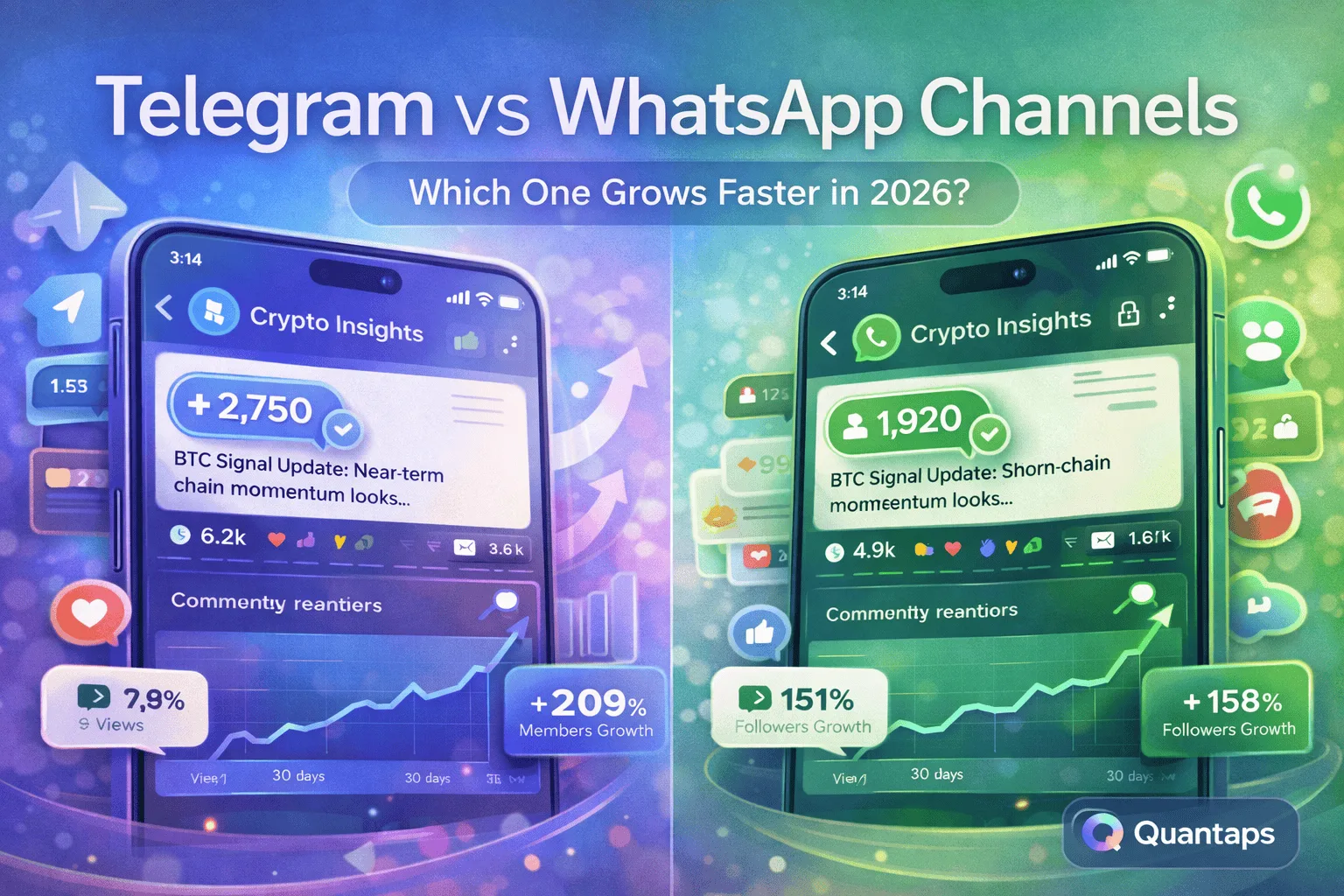
Telegram and WhatsApp Channels are often grouped together because both are used for broadcast-style communication, updates, and community-driven content distribution. But in practice, they do not grow in exactly the same way. Each platform creates a different balance between speed, visibility, audience behavior, and long-term retention.
In 2026, the question is no longer which one is bigger in absolute brand recognition. The more useful question is which one grows faster for a specific content model. For some creators and brands, Telegram still offers stronger expansion mechanics. For others, WhatsApp Channels create lower-friction trust and easier audience comfort. The answer depends on what kind of growth you want and what kind of audience you are trying to build.
Why this comparison matters in 2026
More businesses, creators, analysts, publishers, and community operators are trying to reduce dependence on unstable feed algorithms. That pushes attention toward channel-based communication models where updates can be distributed more directly. Telegram and WhatsApp both sit inside that shift, but they support growth in different ways.
Telegram often attracts operators who want scale, flexibility, and stronger community mechanics. WhatsApp Channels tend to appeal to users who value familiarity, accessibility, and a more mainstream trust environment. When growth strategy is tied to business goals, those differences matter a lot.
Telegram usually grows faster in open distribution environments
Telegram tends to perform well when the audience is already comfortable joining communities, following niche channels, or moving across shared link networks. This makes it especially strong for crypto channels, trading groups, signal communities, news channels, education channels, and topic-based media distribution.
Because Telegram users are often more accustomed to channel discovery and joining behavior, growth can accelerate faster once momentum begins. This is particularly true when content is shareable, frequent, and built around repeat return behavior. Channels aiming to strengthen that visible base often also support growth through services such as Telegram Members, Telegram Post Views, and Telegram Auto Post Views.
WhatsApp Channels can feel easier for mainstream audiences
WhatsApp has a different kind of advantage. The platform feels more familiar to a broader user base, especially for people who already use it daily for personal communication. That existing comfort can reduce hesitation. A user who might ignore a Telegram invitation may still be willing to follow a WhatsApp Channel if the source looks trusted enough.
This means WhatsApp Channels can convert especially well in local markets, brand communities, public figures, news-style updates, and creator-led audiences where frictionless trust matters more than advanced community behavior. For channels building that appearance, related support may include WhatsApp Channel Followers and WhatsApp Channel Post Reactions.
Growth speed depends on discoverability structure
One of the main reasons Telegram often grows faster is discoverability through external sharing and network effects. Telegram links, channel mentions, repost behavior, and cross-channel audience movement can create growth loops that feel more open-ended. This is useful when the goal is aggressive expansion.
WhatsApp Channels are often better for softer trust-based growth, but that growth can feel more limited if the channel is not supported by strong external promotion. In other words, Telegram may win on open expansion mechanics, while WhatsApp may win on user familiarity and comfort once attention is already there.
Telegram is usually stronger for high-frequency content
If the channel strategy depends on frequent posting, recurring updates, trading signals, rapid news, alerts, or heavy post volume, Telegram often has the edge. The user expectation around message frequency is different there. Audiences on Telegram are generally more prepared for channels that update often and operate almost like live feeds.
That makes Telegram structurally attractive for forex, crypto, sports picks, stock alerts, launch communities, and fast-response publishing models. In those cases, post-level visibility becomes critical, which is why operators often care not only about member counts but also about ongoing reach through Post Views and Auto Reactions.
WhatsApp Channels may perform better for lower-noise trust
WhatsApp can be more effective when the communication model is cleaner, lighter, and more selective. Not every audience wants a high-volume stream of content. Some users prefer channels that feel simpler, more curated, and less overwhelming. In those cases, WhatsApp may create better long-term comfort even if raw growth speed is not always as fast as Telegram.
This is especially relevant for public-facing brands, local businesses, lifestyle creators, educators, and communities where audience trust matters as much as size. A channel that feels accessible can sometimes outperform a faster-growing one if the audience quality is stronger.
Retention quality is not the same as growth speed
A platform can grow quickly and still struggle with attention quality. Likewise, a platform can grow more slowly while building a more stable audience relationship. That is why speed alone should not decide the platform choice. Retention behavior matters.
Telegram may offer faster audience growth under the right conditions, but it can also produce more fluctuation if users join quickly and disengage just as quickly. WhatsApp may build slower in some cases, but the follow relationship can feel more deliberate for certain mainstream audiences. The better platform depends on whether your goal is faster scale or steadier trust.
Content format plays a major role
Different content types behave differently across both platforms. Telegram is usually stronger for alerts, data-heavy updates, signals, direct broadcast content, and channels that need immediate repeated visibility. WhatsApp Channels can work well for concise updates, creator notes, brand announcements, public communication, and less aggressive publishing rhythms.
If your content model depends on rapid feed behavior, Telegram often has the structural edge. If your content depends more on broad familiarity and lower-friction audience comfort, WhatsApp becomes more attractive.
For crypto, trading, and finance niches, Telegram often wins
In finance-heavy niches such as crypto, forex, token communities, market commentary, and signal channels, Telegram often grows faster because the ecosystem already supports that kind of behavior. Users in those categories are familiar with channel-based updates, fast alerts, and repeated interaction through shared groups and content loops.
This is one reason Telegram remains especially attractive for operators who need a channel to feel active and scalable. In such spaces, visible growth often works best when member expansion is combined with post-level momentum through Members, Post Views, and Auto Post Views.
For creator trust and public brand communication, WhatsApp can be stronger
WhatsApp Channels may not always produce the same type of aggressive expansion loop, but they can be more attractive for public personalities, consumer-facing brands, and creators who want to meet users in an already trusted environment. Because WhatsApp is deeply integrated into everyday communication, the channel can feel less niche and more familiar.
That matters when the goal is not just rapid member growth but also cleaner perception. A strong WhatsApp Channel can support creator authority, campaign visibility, and repeated brand touchpoints in a way that feels lighter and more approachable to mainstream users.
Which one grows faster in 2026?
In pure expansion terms, Telegram often grows faster when the audience is already comfortable with channel ecosystems, when the content is high frequency, and when the channel is supported by strong external sharing or niche momentum. For aggressive channel growth, it often has the edge.
But WhatsApp Channels can be more effective when the target audience values familiarity, lower friction, and cleaner trust. In those environments, the slower-looking platform can sometimes convert better because people feel safer following the source. So the answer is not universal. Telegram often wins on speed. WhatsApp can win on softer trust-led adoption.
Choosing the right platform depends on the business model
If your priority is fast scale, repeated visibility, niche community behavior, and flexible content velocity, Telegram is usually the stronger pick. If your priority is broader familiarity, lower resistance, and trust-based public communication, WhatsApp Channels may be the better fit.
Some brands will even benefit from using both in different roles: Telegram for higher-frequency community distribution and WhatsApp for softer public-facing brand presence. The platforms do not always compete directly; they can also complement each other depending on channel design.
Growth works best when visible trust supports the channel
Regardless of platform, channel growth becomes easier when the audience sees signs of activity and legitimacy. New users are more likely to stay when a channel looks established, active, and worth following. That is why visible social proof often supports both conversion and retention on channel-based platforms.
For Telegram, that may mean stronger member counts and post visibility. For WhatsApp, it may mean stronger follower presentation and more active post-level response. In both cases, perceived credibility shapes growth outcomes.
Final evaluation
Telegram vs WhatsApp Channels is not really a question of which platform is universally better. It is a question of which one matches the growth mechanics your content needs. If you want fast-moving channel expansion, especially in niche or update-heavy verticals, Telegram usually grows faster. If you want trust-led growth in a more familiar mainstream environment, WhatsApp Channels may be more effective.
In 2026, the channels that grow best are usually the ones matched to audience behavior, publishing rhythm, and perceived trust. The platform matters, but platform fit matters more.