
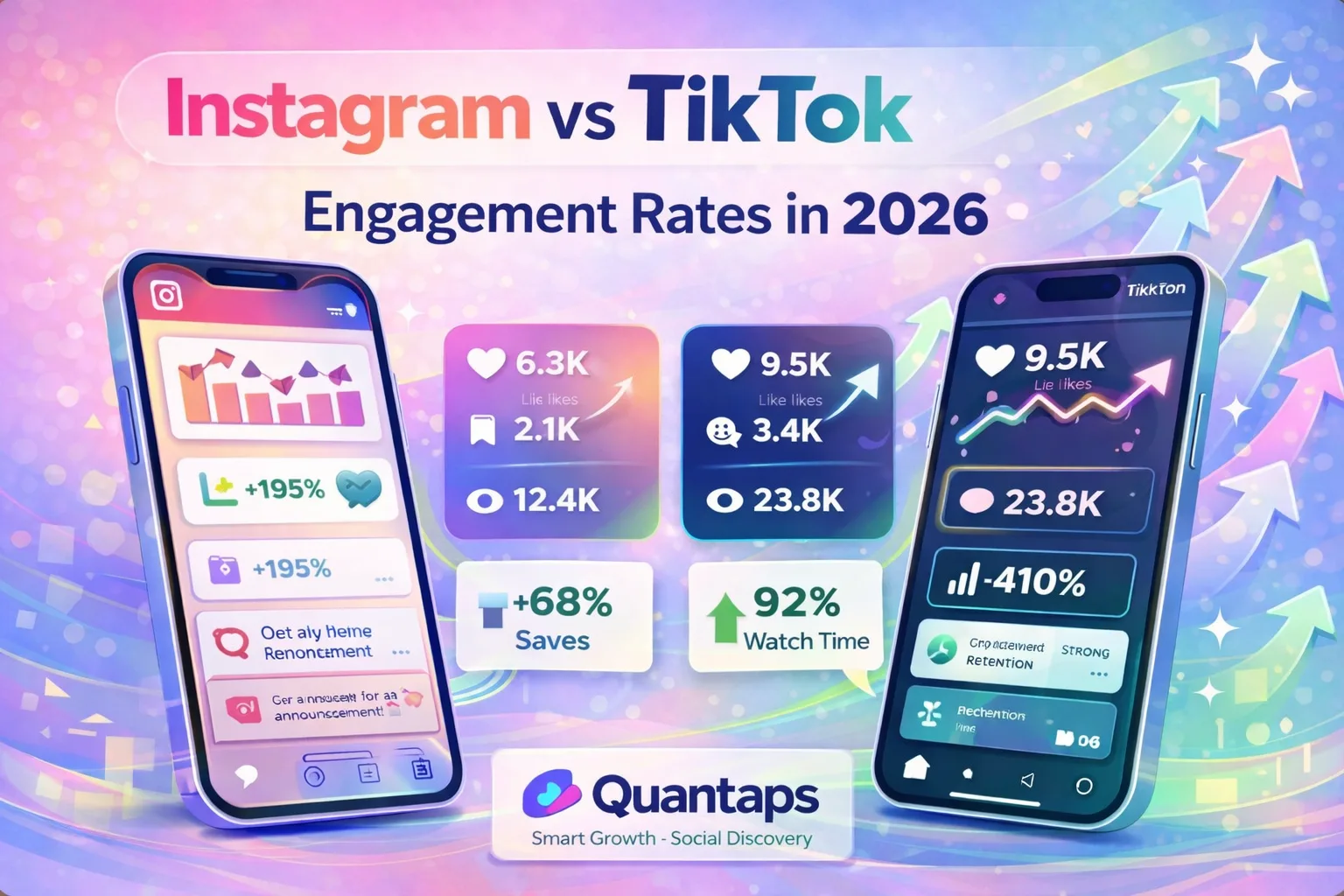
Instagram and TikTok are still the two most important platforms in short-form content, but they do not reward engagement in the same way. Many creators assume that higher likes automatically mean stronger reach on both platforms. In reality, the relationship between engagement and distribution is more complex. What works on Instagram does not always work on TikTok, and what performs on TikTok does not always translate back to Instagram.
In 2026, the most useful way to compare these platforms is not by asking which one is better overall. The better question is what kind of engagement each platform values most when deciding whether content deserves more reach. Once that difference becomes clear, content strategy becomes much easier to improve.
Why engagement rate alone is not enough anymore
For years, marketers treated engagement rate as a simple universal metric. If a post had more likes, comments, shares, or reactions relative to audience size, it was considered successful. That baseline idea still matters, but it is not enough on its own anymore. Platforms have become far more behavior-driven.
Modern content distribution relies less on surface interaction by itself and more on what those interactions suggest about user satisfaction. A fast like can signal light interest, but deeper actions such as saves, shares, watch duration, repeat views, profile visits, and content completion often reveal much more. This is especially important when comparing Instagram and TikTok because each platform reads user behavior through a different lens.
How Instagram interprets engagement in 2026
Instagram still rewards visible engagement, but its ecosystem tends to place stronger weight on content depth and post usefulness. On Reels, watch time and retention remain important, but the platform also gives strong relevance to signals such as saves, shares, profile actions, and how well the content fits follower interest.
This means Instagram often performs best for content that feels reference-worthy, visually polished, and easy to revisit. Educational carousels, useful Reels, clear niche content, and posts that encourage people to save something for later tend to support stronger distribution over time.
For accounts trying to build stronger Instagram momentum, this is also why visible post-level presentation matters. Content often performs better when supported by a profile that already looks active and established through signals like Instagram Followers, Instagram Likes, Instagram Views, and Instagram Saves.
How TikTok interprets engagement in 2026
TikTok remains more aggressively retention-driven. Likes and comments still matter, but they are usually secondary to whether a video can hold attention, create replays, and keep viewers from swiping away. TikTok is less interested in whether content looks polished in a traditional sense and more interested in whether it keeps moving.
This is why some videos with average-looking design still explode on TikTok while highly edited content stalls. The platform responds strongly to fast hooks, short-form clarity, immediate payoff, and strong watch behavior. A video that gets replayed or watched through at high rates can outperform content with cleaner branding but weaker momentum.
That also explains why creators trying to strengthen their TikTok performance often focus not only on content structure but also on broader visibility support through TikTok Views, TikTok Followers, TikTok Likes, and TikTok Shares.
Instagram favors usefulness more clearly
One of the clearest differences between the two platforms is that Instagram often rewards usefulness more visibly. A post that teaches something, organizes information well, or gives people a reason to come back later has a stronger chance of earning saves and shares. That makes educational content structurally important on Instagram.
Even Reels perform better when they feel clear and practical. Tutorials, myth corrections, list-based content, mistakes to avoid, niche advice, and concise explainers often fit Instagram’s engagement logic very well. The platform tends to reward content that users want to keep, revisit, or send to someone else.
TikTok favors momentum more aggressively
TikTok, by contrast, rewards momentum more aggressively. It is not that useful content fails there. It is that usefulness alone is often not enough unless it arrives quickly. A video can contain good information, but if the first seconds do not create curiosity or forward motion, the algorithm may never give it enough room to travel.
On TikTok, packaging is inseparable from reach. Strong pacing, bold framing, short verbal setup, and immediate visual context all matter. If Instagram asks whether a post is worth keeping, TikTok often asks whether a video is worth continuing right now.
What drives stronger reach on Instagram
Instagram reach in 2026 tends to improve when posts generate layered interaction rather than just a burst of light response. Saves, shares, comments with actual intent, profile visits, follows after exposure, and strong watch behavior all suggest deeper content relevance. Reach becomes more durable when the content feels aligned with the account’s audience identity.
This is one reason niche clarity is so important on Instagram. Accounts that repeatedly post content with a consistent topic, visual logic, and audience promise often produce stronger distribution patterns than accounts constantly changing direction. Cohesion supports trust, and trust supports engagement depth.
What drives stronger reach on TikTok
On TikTok, reach is usually driven by a different chain. First-second performance matters heavily. Then retention matters. Then replayability and downstream engagement strengthen the case. If a video creates a strong early response and maintains viewer attention, the platform often expands distribution quickly.
Topic selection also matters here, but not in the same way as Instagram. TikTok topics do well when they are instantly understandable and easy to emotionally process. Reactions, short insights, direct opinions, mistakes, relatable truths, visual reveals, and curiosity-driven statements tend to work because users can understand the premise almost immediately.
Saves vs watch time: one of the biggest platform differences
If someone wanted one practical summary of the difference between Instagram and TikTok, it would be this: Instagram often leans harder on save-worthy value, while TikTok leans harder on watch-worthy momentum. That is not a perfect simplification, but it is directionally useful.
Instagram content benefits when it feels valuable enough to keep. TikTok content benefits when it feels compelling enough to continue. One platform often rewards stored value more clearly, while the other often rewards active attention more aggressively. Understanding this distinction changes how content should be written, edited, and packaged.
Why creators often fail when reposting the same content everywhere
A common mistake is assuming that one short-form video should work equally well on every platform. In practice, reposting the same content without adaptation often weakens performance. The structure that keeps people on TikTok is not always the structure that earns saves and shares on Instagram.
A TikTok-first piece may be too abrupt, too trend-dependent, or too lightweight for Instagram. An Instagram-first piece may be too slow, too text-heavy, or too polished in a way that reduces urgency on TikTok. Distribution improves when the same core idea is packaged differently for each platform rather than copied identically.
Profile trust still shapes engagement quality
Even though algorithmic reach begins at the content level, profile quality still affects what happens after discovery. If a user lands on a page that looks empty, inconsistent, or unestablished, the chance of further engagement often drops. If the page looks active and trustworthy, more viewers convert into followers, return visits, and deeper interaction.
This applies across both platforms. Stronger visible social proof, clearer content positioning, and a more established first impression can support audience confidence. That is why broader growth strategies often extend beyond one metric and include a mix of follower, view, like, comment, and share support depending on the platform and content format.
Which platform is better for educational content?
Educational content can work on both platforms, but it usually behaves differently. Instagram often rewards education when it is structured, clean, and reference-worthy. Carousels, short guides, concise Reels, and posts designed for saves usually fit well. TikTok rewards education when it is compressed into speed, curiosity, and immediate payoff.
So the better platform depends on how the education is packaged. If the content needs layered slides, examples, and reference structure, Instagram may outperform. If the lesson can be delivered in a fast, compelling, visually direct way, TikTok may push it further.
Which platform is better for visibility growth?
TikTok often gives content a faster chance to break beyond an existing audience, especially when hook quality and retention are strong. Instagram can also scale reach, but its performance is often more closely linked to overall profile coherence, post usefulness, and audience trust. In that sense, TikTok may feel more explosive, while Instagram may feel more durable.
That does not mean one should replace the other. In many cases, the strongest strategy is to use TikTok for fast-discovery content and Instagram for depth, brand reinforcement, and sustained audience trust. The platforms work best together when they are treated as complementary rather than identical.
How to build a stronger cross-platform engagement strategy
The practical lesson is simple. If you want stronger Instagram performance, create content people want to save, share, and revisit. If you want stronger TikTok performance, create content people want to continue watching immediately. The same niche can grow on both platforms, but the packaging must match the engagement logic of each system.
For brands and creators building broader multi-platform visibility, this usually means designing separate optimization goals instead of chasing one abstract engagement rate. Instagram may demand stronger save value and profile trust. TikTok may demand stronger hooks and tighter retention. Growth becomes more predictable when those differences are respected.
Final insight
In 2026, engagement is no longer just a visible number. It is a behavioral language that platforms interpret differently. Instagram tends to value depth, usefulness, and trust-rich interaction. TikTok tends to value momentum, retention, and immediate viewer response. Reach grows when your content matches the logic of the platform it is published on.
The creators who perform best are usually not the ones copying the same formula everywhere. They are the ones who understand what each platform is trying to measure and then build content that fits that system more precisely.