
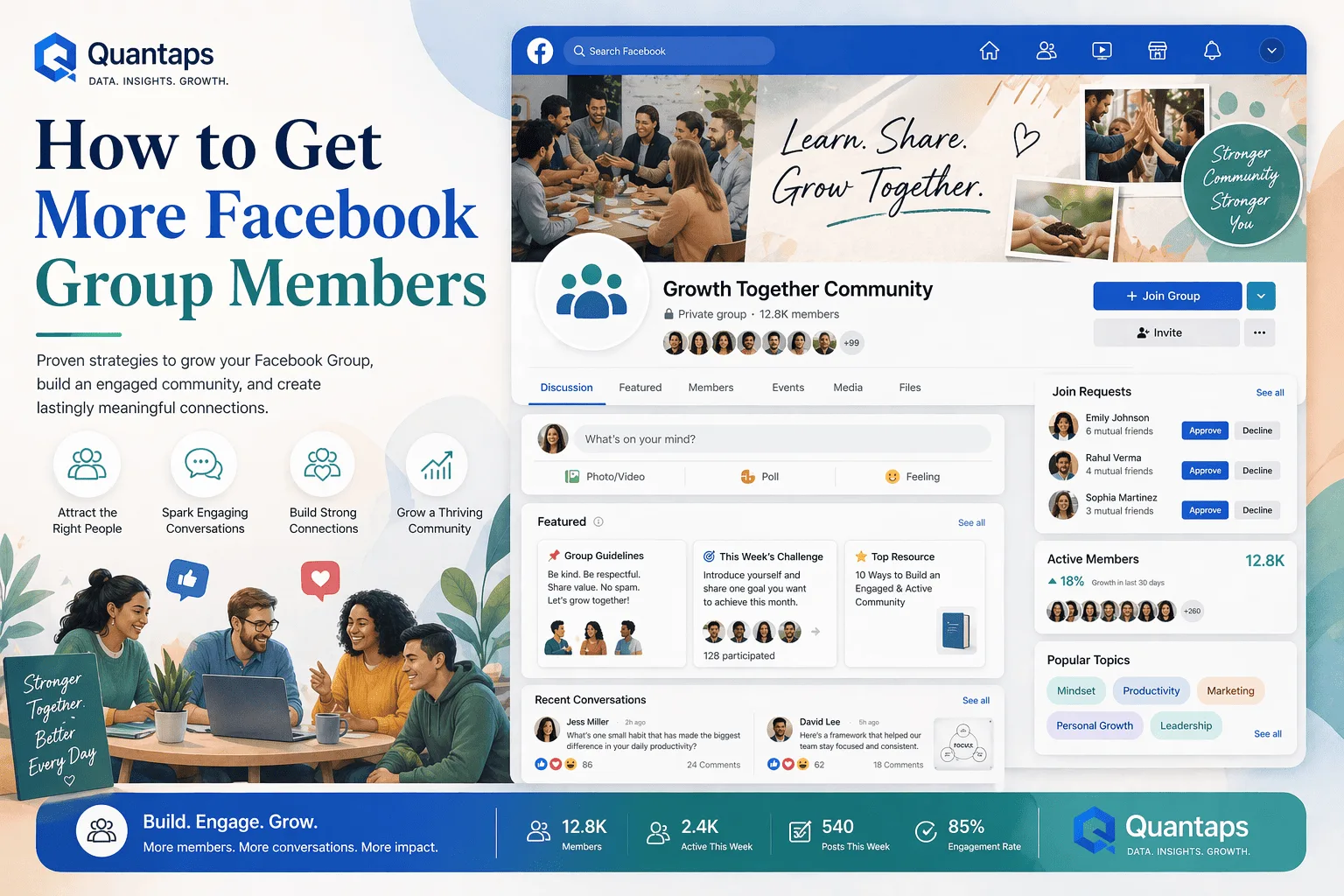
Getting more Facebook Group members can make a major difference in how a community grows, how active it feels, and how seriously people take it. On Facebook, groups are not only places for discussion. They are also social environments where visible member count influences first impression. A group with stronger public size often feels more established, more relevant, and more worth joining than one that appears nearly empty.
In 2026, community growth depends heavily on trust and perceived momentum. People do not join groups only because they exist. They join when the group looks useful, active, and socially validated. That means member count matters not just for size, but for how the community is interpreted before users even read many posts.
Why Facebook Group members matter
Facebook Group members matter because they shape how the community looks from the outside. A larger-looking group usually feels more active and more credible than a very small one. This changes how people behave when they first encounter it. They are more likely to enter, browse, and consider joining when the group already appears to have social traction.
That does not mean size is everything. But on group-based platforms, size often acts as a trust shortcut. A visible member base suggests that the community already offers enough value for others to stay involved. That can strongly influence whether new users decide to join as well.
Groups are judged by momentum
One of the biggest differences between a page and a group is that groups are often evaluated as living communities. Users want to know whether there is energy inside, whether discussion happens, and whether the group feels worth being part of. Member count contributes to that sense of momentum.
A group that looks too small may feel inactive before the user even checks the posts. A group with stronger visible membership can feel more alive at first glance, which improves the odds of deeper exploration.
Why some Facebook Groups struggle to grow
Many groups struggle because they do not communicate enough value or social proof. Sometimes the topic is too broad. Sometimes the group looks inactive. Sometimes it has useful content, but the member count is too low to create confidence. In other cases, the group lacks visible identity and therefore feels easy to ignore.
Users rarely want to be early in a group that feels uncertain. They are more comfortable joining communities that already look somewhat established. This is why visible membership matters so much during growth stages.
Member count affects first impression immediately
When people encounter a Facebook Group, they often notice the name, cover, and member size almost instantly. That number helps them decide whether the group feels important enough to inspect further. A higher visible member count often makes the group look more legitimate.
This matters because many users are scanning quickly. They are not always reading every description line before judging the community. They are using visible signals to decide whether the group deserves more attention. Stronger member count helps that decision lean in your favor.
Group size reduces hesitation
Joining a group is a social action. Even when it is simple, people still want to feel that they are joining something real. A group with stronger member count reduces hesitation because it looks less uncertain. It suggests that others have already judged the group worth entering.
This lowered hesitation can improve join rates, browsing time, and willingness to participate later. In practical terms, the group becomes easier to trust before a new member fully understands its value.
Facebook Group members support community trust
Community trust is not built through size alone, but size is often part of the picture. A visible member base helps the group feel more legitimate, more stable, and more socially proven. This is especially important for niche groups, business groups, local communities, private-interest groups, or creator-led communities that depend on perceived relevance.
When people see that a group already has members, they are more likely to assume the community offers something useful. That assumption gives the group a stronger starting point in the mind of the visitor.
Member count can improve engagement conditions
A stronger-looking group does not just attract more joins. It can also create better conditions for future engagement. When people join a community that already appears active, they are more likely to expect discussion, value, and continuity. That changes how they behave once inside.
In other words, visible member growth can improve the social environment around the group. It helps the community feel more viable, which supports longer-term participation patterns over time.
Groups need clear purpose as well as visible size
Member count works best when the group’s purpose is easy to understand. If a group has strong numbers but unclear identity, the growth effect becomes weaker. Users need to know what the community is for, who it serves, and why joining makes sense.
This is why the best-growing groups usually combine visible size with clear positioning. When both are strong, the group feels easier to trust and easier to join.
Facebook Group growth works especially well for niche communities
Groups perform best when they give people a reason to belong. This can be built around local interests, professional topics, hobbies, customer communities, creator audiences, educational niches, or shared goals. In these settings, member count becomes even more powerful because it signals that the niche has already found social traction.
For niche communities, visible membership helps answer an important question for new users: is this actually a real place where people gather? Stronger member size makes that answer feel more clearly yes.
Group members and page signals can support each other
Many brands and creators build on Facebook through more than one surface. A page may support brand trust, a public profile may support personal credibility, and a group may support community depth. These layers can reinforce one another when they are aligned properly.
Depending on the broader strategy, related trust and growth paths may also connect naturally with Facebook Page Likes and Facebook Profile Followers.
Member growth helps groups look less empty
One of the biggest visual problems for newer Facebook Groups is the appearance of emptiness. Even if the intention behind the community is strong, low visible membership can make the group look too early-stage or too uncertain. That creates friction before the content has any chance to work.
Group members help reduce that empty look. They make the community feel more formed and more socially validated, which improves how users interpret the group as soon as they encounter it.
How admins usually use Facebook Group members
Group owners often focus on member growth because they want the community to look more established, improve join confidence, and create a stronger sense of public activity around the group. The goal is usually not just to increase size, but to improve the way the group is perceived from the outside.
For communities that want stronger visible social proof, Facebook Group Members can help support public group appearance while content, moderation, and long-term community-building continue to develop.
Community growth is easier when the group already feels real
One of the biggest challenges in group growth is that people prefer joining something that already feels socially real. They want evidence that the group is not empty, abandoned, or irrelevant. Visible member count helps provide that reassurance quickly.
This is why group size often helps growth compound. A stronger-looking group earns more interest, which can then support more real activity and more future trust. The group begins to feel like a community instead of just a container.
Final evaluation
Facebook Group members matter because they strengthen first impression, reduce hesitation, improve community trust, and help groups look more active and worth joining. In social environments built around belonging, visible member count remains one of the clearest public signals users notice right away.
In 2026, Facebook Group growth is not only about what happens inside the community. It is also about whether the group looks established enough from the outside to attract new people in the first place. Facebook Group members can help support that perception and give a community a stronger foundation for long-term growth.